
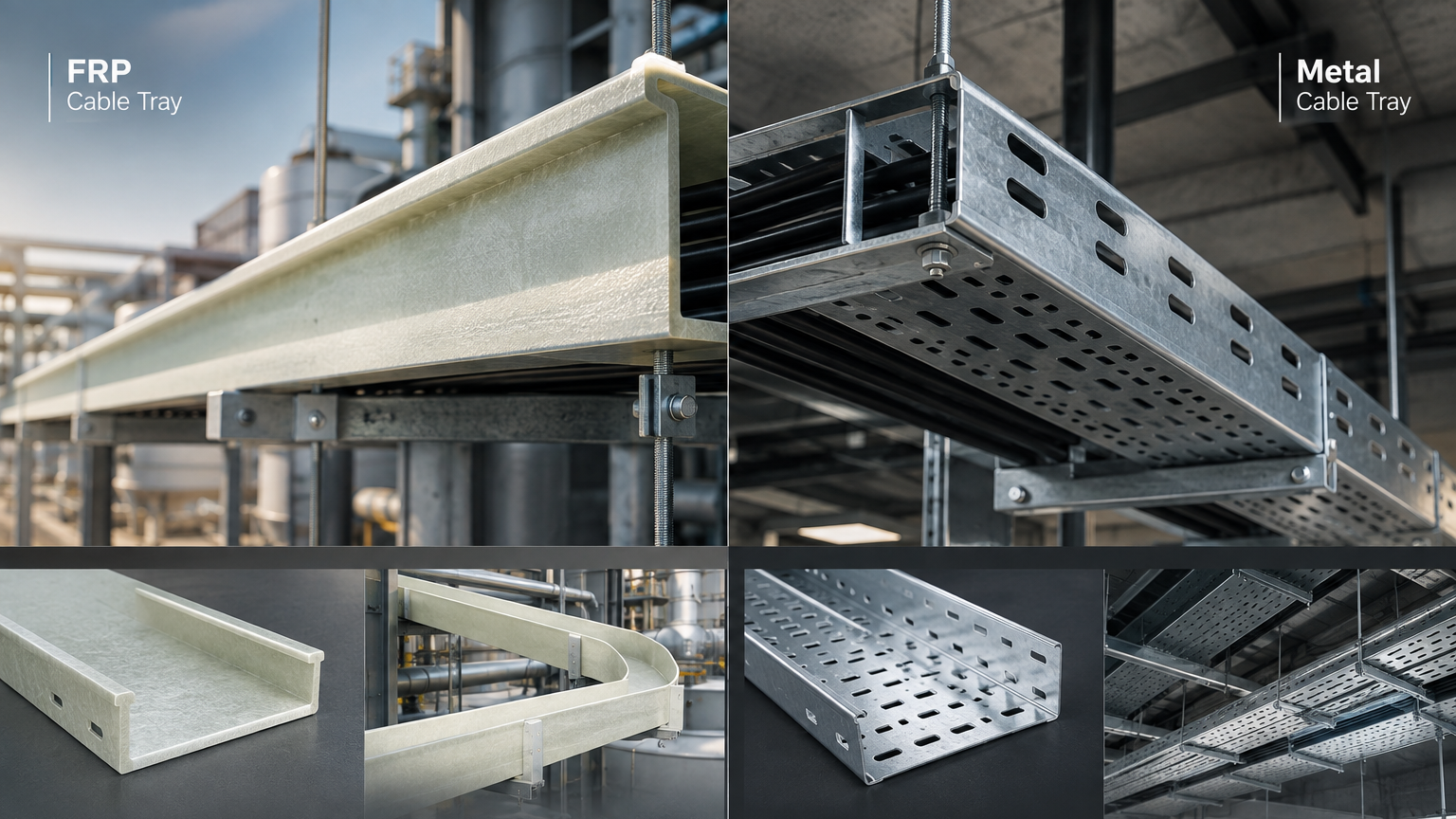
What Is an FRP Cable Tray?
DLINEE FRP Cable Tray is described by TBP as a corrosion-resistant, lightweight, and high-strength cable-management solution for industrial environments. It is intended to provide cable support and routing in demanding operating conditions.
The DLINEE range includes straight tray and cover tray configurations in multiple standard widths, heights, and thicknesses, together with fittings for horizontal and vertical direction changes, tee connections, and reducers.
FRP vs Metal Cable Tray: What Changes?
The DLINEE catalogue uses the same broad FRP material comparison framework applied across TBP products: corrosion resistance, lightweight construction, non-conductivity, chemical resistance, and low-maintenance positioning are emphasized for FRP when compared with conventional steel.
Those characteristics can influence material selection, but they do not remove the need to check cable load, support spacing, routing geometry, project standards, installation environment, and any required fire or electrical performance.
Practical Material Considerations
The following comparison stays within the qualitative characteristics documented by TBP and avoids unsupported installation-time, cost, or service-life percentages.
| Consideration | FRP cable tray | Conventional metal tray |
|---|---|---|
| Corrosion | Positioned for corrosion-resistant industrial use | Protection needs depend on the metal and environment |
| Weight | Positioned as lightweight | Typically heavier material handling |
| Conductivity | Non-conductive FRP material | Conductive metal material |
| Chemical exposure | Resistance depends on resin and actual exposure | Resistance depends on metal grade/coating and exposure |
| Maintenance | Positioned as low maintenance | Maintenance strategy depends on corrosion protection and environment |
Corrosion and Chemical Exposure
DLINEE is positioned for industrial environments where corrosion and chemical exposure can affect conventional cable-support materials. This includes applications listed by TBP such as chemical-processing plants, oil and gas refineries, water-treatment facilities, marine environments, and other industrial facilities.
Chemical resistance should still be checked against the actual resin system and exposure conditions. A general FRP label is not a substitute for a project-specific compatibility review.
Weight, Handling, and Installation
The DLINEE catalogue describes FRP cable support as lightweight. This can be relevant to transport and handling, especially where routing extends across large industrial facilities.
The catalogue does not provide a universal labor-saving or installation-time percentage, so those outcomes should be evaluated from the actual tray size, support layout, site access, and installation method.
Electrical Conductivity and Cable Routing
FRP is described by TBP as non-conductive. For cable-management projects, that material characteristic may be part of the selection discussion, but it should not be interpreted as an electrical-code, hazardous-area, or explosion-proof certification.
Routing flexibility also depends on available fittings. DLINEE lists 90° horizontal elbows, inside and outside vertical elbows, horizontal equal tees, and left/right reducers for Cable Tray, with custom sizes available upon request.
Available DLINEE Cable Tray Configurations
The catalogue provides straight and cover tray configurations. Standard cover widths include 50, 100, 200, and 300 mm at 3000 mm length, while straight trays are listed across combinations of 50 or 100 mm height and widths from 50 to 300 mm depending on the configuration.
The correct configuration should follow the cable-routing requirement, available space, support arrangement, and project specification rather than simply selecting the largest standard size.
Choosing Between FRP and Metal Cable Tray
The material decision should be made from the actual environment and cable-support requirement. Corrosion exposure, chemical exposure, routing geometry, tray dimensions, support spacing, cable load, maintenance strategy, and applicable project standards should all be checked before specification.
TBP's DLINEE catalogue provides the FRP product range and configurations. Project-specific comparison against a selected metal system should use the metal product's verified technical data rather than a generic assumption about all metal trays.
Technical Note
This article does not generalize DLINEE Cable Ladder load-test results to Cable Tray. Any project-specific structural, electrical, fire, or hazardous-area requirement should be verified against the applicable product and standard documentation.