
What Is FRP Grating?
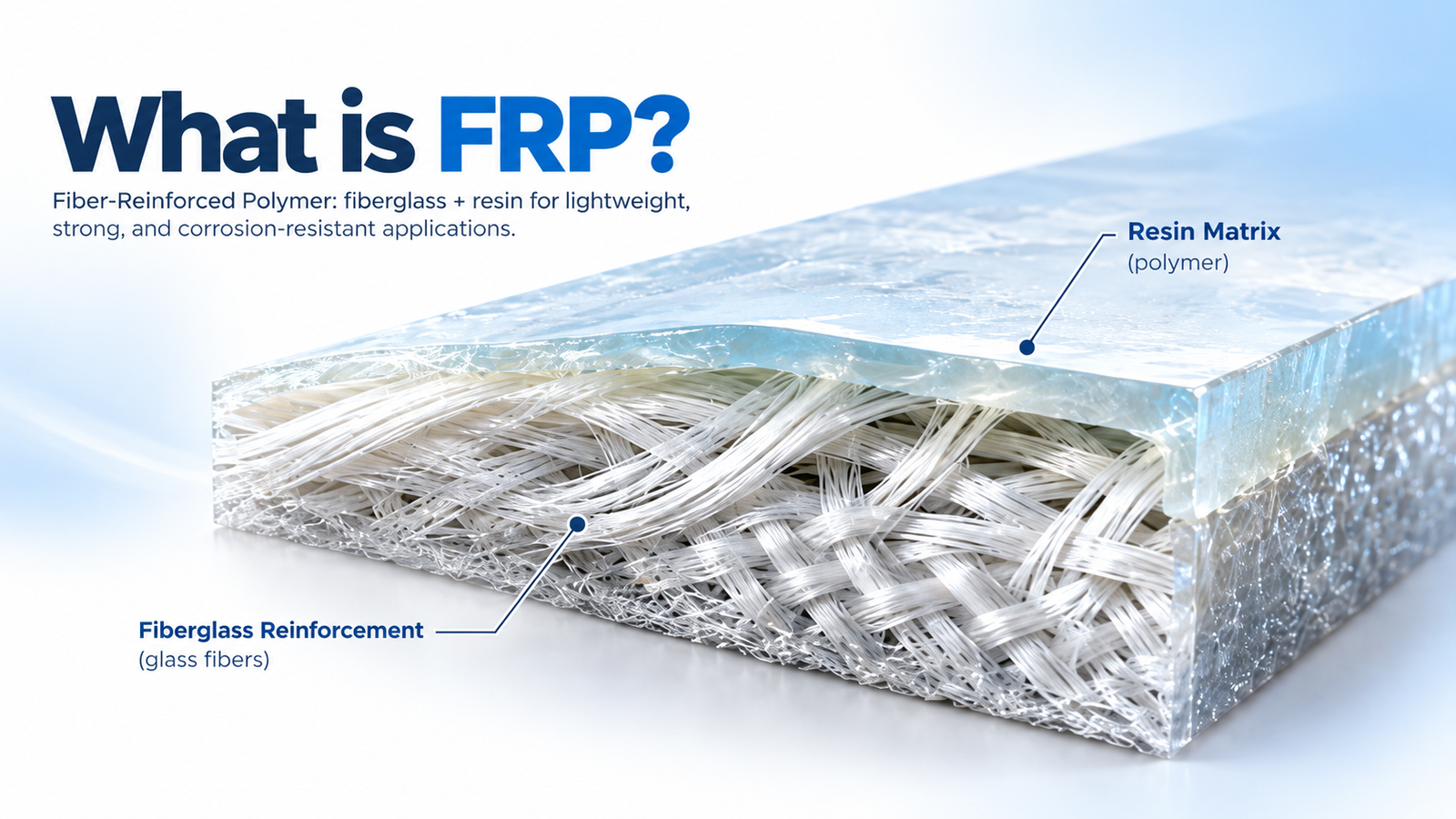
FRP stands for Fiberglass Reinforced Polymer. In the DGRID product family, TBP manufactures moulded FRP grating using continuous fiberglass reinforcement and thermosetting resin in a one-piece moulded construction.
The resulting grid is positioned for industrial environments where corrosion resistance, lightweight construction, slip resistance, and long-term durability are important considerations. DGRID also includes FRP Grating Plat Bordes for applications that require a checkered surface and a more closed walking surface.
How Moulded FRP Grating Is Constructed
DGRID moulded grating combines fiberglass reinforcement with thermosetting resin in a moulded grid structure. The catalogue presents this construction as a one-piece system rather than an assembly of separate bars.
This construction is used across several mesh and height configurations. Standard DGRID options include 38 × 38 mm mesh in 25 mm, 38 mm, and 50 mm heights, together with a 50 × 50 mm mesh option at 50 mm height.
Key Characteristics of FRP Grating
The DGRID catalogue highlights several characteristics that can make FRP grating relevant to industrial environments. These are material and product characteristics rather than a guarantee that every configuration is suitable for every project.
- Corrosion resistance for environments exposed to moisture or corrosive conditions.
- Lightweight construction compared with conventional heavy materials.
- Non-conductive material characteristics.
- Chemical resistance, subject to the resin system and actual exposure conditions.
- Slip-resistant surface options for access and walking areas.
- Low-maintenance positioning for industrial use.
Common DGRID Types and Surface Options
TBP groups DGRID into FRP Moulded Grating and FRP Grating Plat Bordes. Moulded Grating retains the open-grid form, while Plat Bordes uses a checkered surface and is available in open-back and close-back configurations.
For moulded grating, the catalogue lists three surface treatments: textured anti-skid, concave, and smooth. Textured anti-skid is intended for stronger grip in wet or oily areas, concave surfaces are positioned for high-moisture or contaminant-prone environments, and smooth surfaces are intended for general applications where slip resistance is not the primary requirement.
- Available catalogue colors: Yellow and Light Grey.
- Moulded Grating: open-grid industrial access and flooring applications.
- Plat Bordes Open Back: checkered surface with the grating structure visible below.
- Plat Bordes Close Back: checkered surface with a fully enclosed underside.
Where FRP Grating Is Used
The DGRID catalogue documents FRP grating across several industrial access and flooring applications. The common theme is the need for durable access surfaces in environments affected by moisture, chemicals, corrosion, maintenance activity, or ventilation requirements.
- Walkways and platforms.
- Trench covers and drainage areas.
- Mezzanines and catwalks.
- Water-treatment inspection walkways.
- Stair treads and maintenance access.
- Marine, dock, and offshore environments.
- Chemical-processing environments.
- Solar-panel access walkways and ventilated-room panels.
What to Consider When Selecting FRP Grating
FRP grating selection should start with the actual operating environment and access requirement, not only the product name. Mesh size, grating height, panel dimensions, surface type, exposure conditions, and the intended use all affect the final product choice.
Where structural load, span, fire performance, chemical compatibility, or a specific standard is important, the final selection should be confirmed against the applicable project requirement and the current technical documentation.
Technical Note
This article summarizes product characteristics documented in the TBP DGRID Catalogue 2026. Project-specific suitability should be confirmed against the required dimensions, operating conditions, loads, and applicable specifications.