
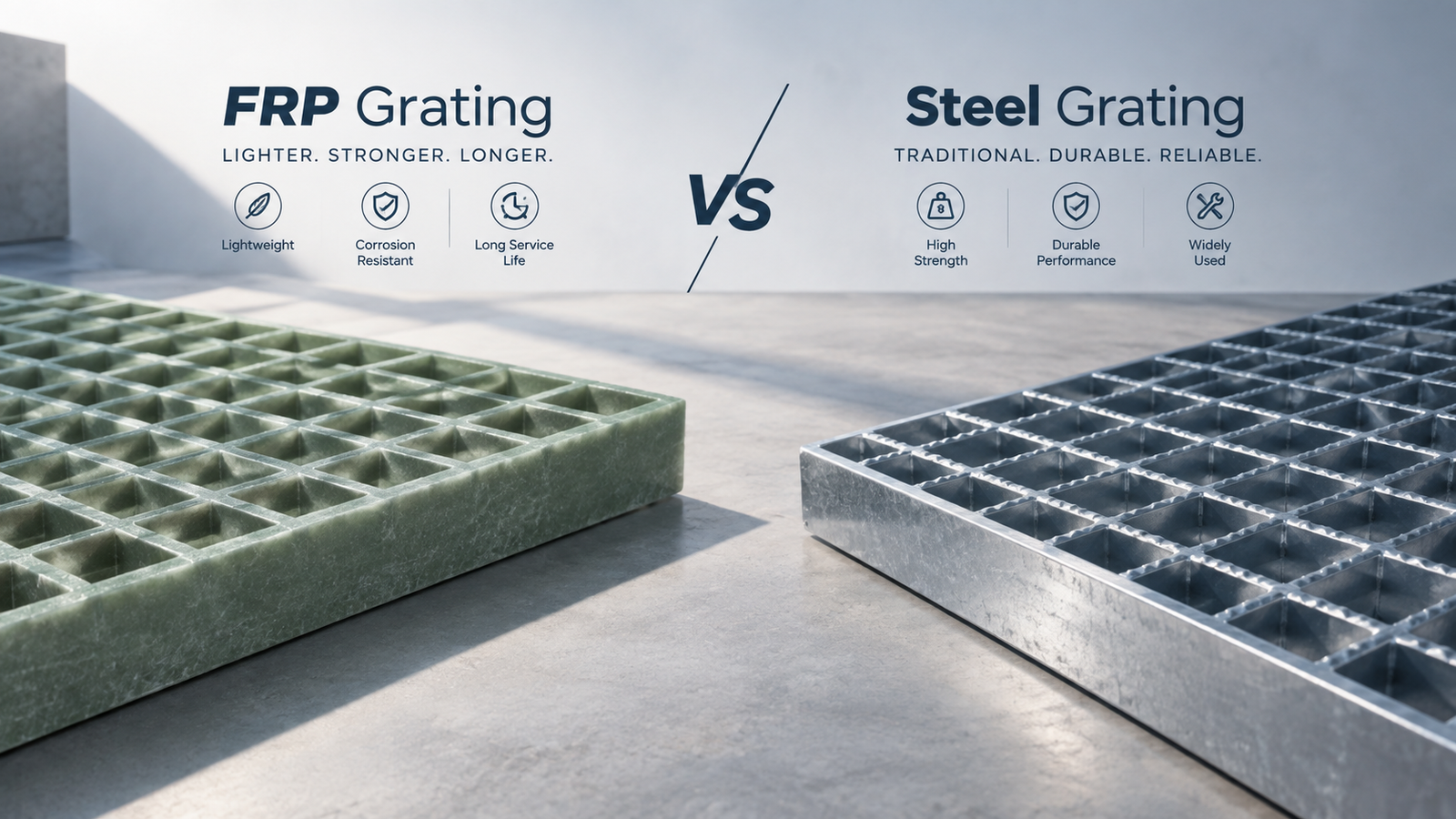
FRP Grating and Steel Grating Serve Different Requirements
The DGRID catalogue compares FRP composite with conventional steel across corrosion resistance, weight, maintenance, electrical conductivity, chemical resistance, and service-life positioning. These factors can materially affect product selection in industrial environments.
The comparison should still be read as a material-selection framework, not as a statement that FRP is automatically the correct choice for every structure. Load requirements, operating temperature, fire requirements, project standards, support conditions, and other project-specific criteria remain important.
Key Differences Highlighted in the DGRID Catalogue
The table below summarizes the qualitative comparison presented in TBP's FRP catalogue. It intentionally avoids unsupported percentage savings, lifetime estimates, or structural equivalence claims.
| Consideration | FRP grating | Conventional steel |
|---|---|---|
| Corrosion | Positioned as corrosion resistant | Can require corrosion protection and coating |
| Weight | Positioned as lightweight | Heavier material handling |
| Maintenance | Positioned as low maintenance | May require inspection and repainting/protection |
| Electrical conductivity | Non-conductive material characteristic | Conductive material |
| Chemical exposure | Chemical resistance depends on the resin and exposure | Susceptibility depends on metal grade, coating, and exposure |
Corrosion Resistance
Corrosion is one of the clearest differences emphasized by the DGRID catalogue. FRP is positioned for environments where moisture, chemicals, or salt exposure can make corrosion a recurring material-selection concern.
For steel, the catalogue comparison notes the need for coating and protection where corrosion is a concern. That does not mean all steel performs the same way; actual performance depends on the steel grade, protection system, and environment.
Weight and Handling
TBP positions FRP grating as lightweight, which can simplify handling and transport compared with heavier conventional grating materials. The catalogue does not provide a universal percentage reduction, so this article does not assign one.
For a real project, panel dimensions, lifting method, access constraints, and installation conditions should be reviewed before drawing conclusions about handling effort or installation cost.
Electrical Conductivity
DGRID identifies FRP as non-conductive, while conventional steel is conductive. This material characteristic can be relevant where electrical conductivity influences the design or maintenance environment.
Non-conductive does not automatically mean that a grating system satisfies a particular electrical-safety standard or project requirement. Those requirements must be verified separately.
Maintenance and Chemical Exposure
The catalogue positions FRP as low maintenance and chemically resistant compared with conventional steel. For chemical exposure, however, suitability is condition-specific: resin system, concentration, temperature, duration, and the exact chemical environment all matter.
Steel can also be specified with different grades and protective systems, so final comparison should be based on the project's actual exposure and maintenance strategy rather than a generic material label.
Which Material Fits the Application?
A practical choice should compare the operating environment, required dimensions, structural requirements, surface needs, maintenance approach, applicable standards, and project budget. The DGRID catalogue provides FRP product data, but it does not replace project-specific engineering or specification review.
For TBP applications, DGRID is intended for industrial access and flooring use cases such as walkways, platforms, drainage covers, stairs, water-treatment access, marine environments, and chemical-processing areas.
Technical Note
This comparison is intentionally qualitative and source-bounded. Quantitative lifecycle cost, installation-time, structural, and fire-performance comparisons require separate authoritative project evidence before publication or specification.